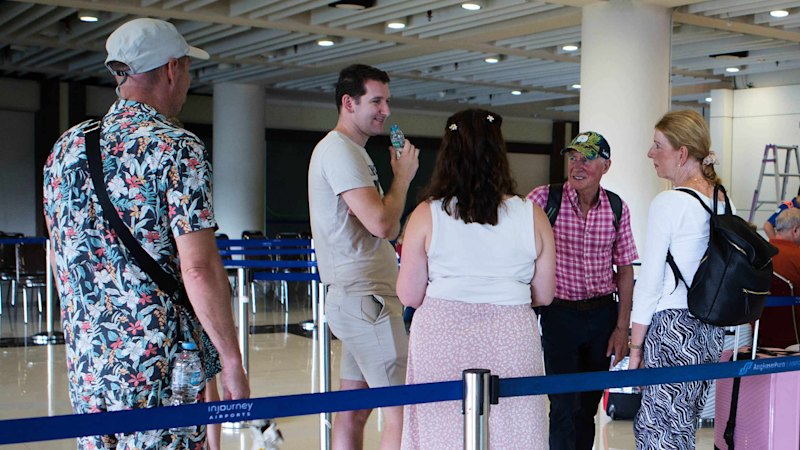
The terminal floor in Dubai is a specific kind of cold. It is a sterile, expensive chill that seeps through a designer hoodie and settles in the marrow of your bones when you realize the gate screen isn't going to change. For three thousand Australians, that cold became the defining sensation of forty-eight hours they will never get back.
Sarah, a fictional but representative composite of the frantic faces lining the Emirates desks, wasn't thinking about international diplomacy or fuel hedging. She was thinking about her daughter’s third birthday in Brisbane, a cake shaped like a ladybug, and the fact that her boarding pass had just become a useless scrap of thermal paper. She is the human face of "travel mayhem." To the spreadsheets in Canberra and the flight operations centers in the UAE, she is a data point. To herself, she is a woman losing a piece of her life to a logistical void.
The breakdown wasn't just a delay. It was a systemic seizure. When the gears of the massive aviation corridor between Australia and the Middle East grind to a halt, the ripple effects don’t just move; they accelerate.
The Anatomy of a Standstill
International air travel relies on a fragile, invisible clockwork. We take for granted that a metal tube can catapult us across the planet in twenty hours, but that miracle is held together by paper-thin margins of timing and diplomatic goodwill. When a crisis of this scale hits, the "mayhem" reported in the headlines feels like a polite understatement.
It starts with a whisper in the crew lounge. Then, a notification pings on a thousand phones simultaneously.
The physical reality of three thousand stranded souls is a logistical nightmare. Imagine the sheer volume of water, food, and floor space required when an entire small town’s worth of people is suddenly dropped into a transit lounge with no exit strategy. The hotels fill first. Then the premium lounges. Finally, the terminal floor becomes a mosaic of sprawled limbs and makeshift pillows.
This isn't just about missing a flight. It’s about the suspension of agency. In a foreign airport, without a valid boarding pass, you are a ghost. You cannot leave the airport without a visa you don't have, and you cannot board a plane that isn't coming. You are stuck in the "in-between."
The View from the Lodge
While Sarah was trying to find a power outlet that worked, Prime Minister Anthony Albanese was entering a different kind of room. The stakes in a crisis talk with the UAE aren't just about getting those three thousand people home; they are about the future of the Australian sky.
Australia is an island nation. We don't have the luxury of high-speed rail to our neighbors. Our economy, our family ties, and our sense of global belonging are entirely dependent on the grace of long-haul carriers. When the UAE—the primary transit hub for almost every Australian heading to Europe—experiences a "convulsion" in service, it is a national security issue disguised as a travel inconvenience.
The Prime Minister’s intervention is a rare lever to pull. Usually, these glitches are handled by airline algorithms. When the leader of a country has to pick up the phone, it means the algorithm has failed. It means the "invisible hand" of the market has tucked its fingers into a fist.
The discussions aren't just about the current backlog. They are about landing rights, bilateral agreements, and the unspoken pressure of competition. Australia needs the UAE’s infrastructure, and the UAE needs Australia’s affluent, long-haul travelers. It is a marriage of convenience that, for forty-eight hours, felt like a messy divorce.
The Invisible Stakes
Why does this matter beyond the immediate frustration of a canceled holiday?
Consider the "Just-in-Time" nature of modern existence. We live our lives assuming the bridge will always be there. We book weddings, we schedule surgeries, and we sign contracts based on the reliability of a flight schedule.
When that schedule breaks, the cost is measured in more than just refund checks.
- The Emotional Tax: The panic of a parent stuck five thousand miles away from a sick child.
- The Economic Friction: Hundreds of thousands of dollars in lost productivity as specialists and executives sit idle in departure lounges.
- The Fragility of Trust: Every time this happens, the world feels a little larger, a little more dangerous, and a little less connected.
We often talk about the "global village," but a village is only a village if you can walk across it. When the sky breaks, the village becomes a series of isolated fortresses.
The Logistics of a Rescue
Clearing a backlog of three thousand people isn't as simple as "sending another plane."
Every aircraft has a tail number, a maintenance schedule, and a crew that is legally mandated to sleep. You cannot simply conjure a Boeing 777 out of thin air. To move the stranded, you have to bump others. You have to re-route cargo. You have to negotiate new slots with Air Traffic Control in dozens of different jurisdictions.
It is a high-stakes game of Tetris played with lives and millions of dollars. The pressure on the ground staff is immense. They are the ones who have to look Sarah in the eye and tell her that, no, they don't know when the ladybug cake will be cut. They are the lightning rods for a frustration they didn't cause and cannot fix.
The Aftershocks
The crisis talks in the UAE will eventually produce a joint statement. There will be talk of "strengthening ties" and "future-proofing corridors." The planes will eventually take off, the terminal floors will be swept, and the designer hoodies will be washed.
But the scar remains.
For the traveler, the next booking comes with a side of anxiety. You check the news more often. You look at the "fine print" on your travel insurance with a cynical eye. You realize that your "right" to travel is actually a fragile privilege, subject to the whims of weather, politics, and mechanical entropy.
The real story isn't the "mayhem." It’s the realization of how thin the ice is. We spend our lives flying over oceans, trusting that the systems we’ve built are indestructible. Then, a weekend in Dubai reminds us that we are just passengers in a machine that is much bigger, and much more temperamental, than we care to admit.
The ladybug cake was eaten two days late. It tasted like cardboard and exhaustion. Sarah finally made it home, but as she watched her daughter blow out the candles, she couldn't stop looking at her phone, checking for an alert that wasn't there, waiting for the sky to fall again.