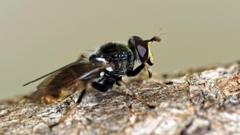
In the high-altitude forests of the Cairngorms, a small, orange-bottomed insect is currently the most expensive and labor-intensive tenant in the Scottish Highlands. The pine hoverfly (Blera fallax) was, until very recently, a ghost. For nearly a decade, not a single adult was spotted in the wild. It had been reduced to a "relict population," a polite scientific term for a species on the absolute brink of blinking out. This month, conservationists at the Royal Zoological Society of Scotland (RZSS) marked a staggering milestone: the release of their 30,000th captive-bred larva. This effort relies on a low-tech, domestic irony. The future of a Critically Endangered species depends entirely on thousands of recycled jam jars.
While the "jam jar" narrative makes for a charming headline, it masks a grim reality about the state of British biodiversity and the extreme measures required to fix it. The pine hoverfly is as rare as the Scottish wildcat and arguably more vital to the local ecosystem's plumbing. It is a dual-threat specialist, acting as both a pollinator for the forest understory and a biological recycler in its larval stage. The fact that it requires thousands of man-hours and glass pantry staples to survive reveals a total systemic failure in how we manage old-growth forests.
The Rot Hole Crisis
The decline of the pine hoverfly is not a mystery; it is a housing shortage. The fly has an incredibly narrow biological requirement for its nurseries. It only lays eggs in the "heartwood soup" of ancient Scots pine stumps. These are wet, decaying cavities where specific fungi, like Phaeolus schweinitzii, have softened the wood.
Modern forestry is the enemy of the rot hole. In a commercial timber landscape, trees are harvested long before they reach the age where they can develop these natural cavities. Even in protected areas, the lack of large-scale, fallen deadwood means there is nowhere for the next generation of flies to hatch. We have created "clean" forests that are, for a specialized invertebrate, biological deserts.
To bridge this gap, zookeepers at the Highland Wildlife Park have turned to a meticulous form of alchemy. They fill jam jars with a specific "mulch" of pine sawdust and water, mimicking the chemical composition of a rotting stump. It is a slow, manual process. Each jar represents a potential life, but it also represents the artificial life support system we have been forced to build because the natural forest can no longer provide the basics.
Beyond the Jar
The RZSS breeding program, which moved from Edinburgh Zoo to a dedicated facility in the Highlands, has become a production line for biodiversity. In March 2026 alone, nearly 7,000 larvae were deposited into the wild across four key sites, including land managed by RSPB Scotland and Forestry and Land Scotland.
However, releasing larvae is only half the battle. If those larvae grow into adults and find no natural rot holes to lay their own eggs in, the 30,000 releases are just a temporary delay of the inevitable. This is why the project has shifted toward "habitat engineering."
Field officers are now using chainsaws to carve artificial rot holes into stumps, attempting to jump-start the decay process that nature usually takes decades to complete. They are also focusing on the "flowering understory." Adult flies need nectar, specifically from rowan trees, to survive their brief few weeks of life in the summer. A forest that is just a monoculture of pine—no matter how many jam-jar larvae you dump into it—will eventually become a graveyard for the species.
The Cost of Specialized Survival
There is a valid, if uncomfortable, question often whispered in conservation circles: why expend this much effort on a fly?
The answer lies in the "umbrella effect." When you manage a forest for the pine hoverfly, you are inadvertently saving dozens of other species. The blood-red longhorn beetle and various rare moths also thrive in the exact same messy, "unmanaged" conditions the fly requires. By obsessing over the fly, we are forced to restore the complexity of the Caledonian forest.
This is not cheap work. The program is supported by the Scottish Government’s Nature Restoration Fund and various corporate partners, but it remains a fragile operation. It relies on a tiny team of specialists who spend their winters in the hail and wind of the Cairngorms, hand-placing larvae into stumps.
A Wild Generation
The real breakthrough came not with the 30,000th release, but with what happened afterward. For the first time in years, researchers are beginning to find "wild-bred" individuals at the release sites. This means the captive-bred flies are successfully finding mates, finding (mostly artificial) rot holes, and completing their life cycle without human intervention.
This is the ultimate goal of any reintroduction: to become unnecessary. We are not there yet. The population is still geographically isolated and vulnerable to a single bad season or a localized disease. The reliance on jam jars and hummus pots—used for the pupation stage—is a testament to human ingenuity, but it is also a badge of shame for how we have stripped the landscape of its natural complexity.
The success in the Cairngorms proves that we can pull a species back from the very edge of the void. But it also serves as a warning. If we continue to treat forests as mere timber crops rather than living, decaying ecosystems, the jam jars will never be enough.
The next phase of the Pine Hoverfly Conservation Strategy involves expanding to new sites across the Highlands. The project is no longer just about preventing an extinction; it is about proving that we can rebuild a functioning ecosystem from the bottom up, one larva at a time. The flies are back, but their future depends on our willingness to let the forest grow old, get messy, and rot in peace.


