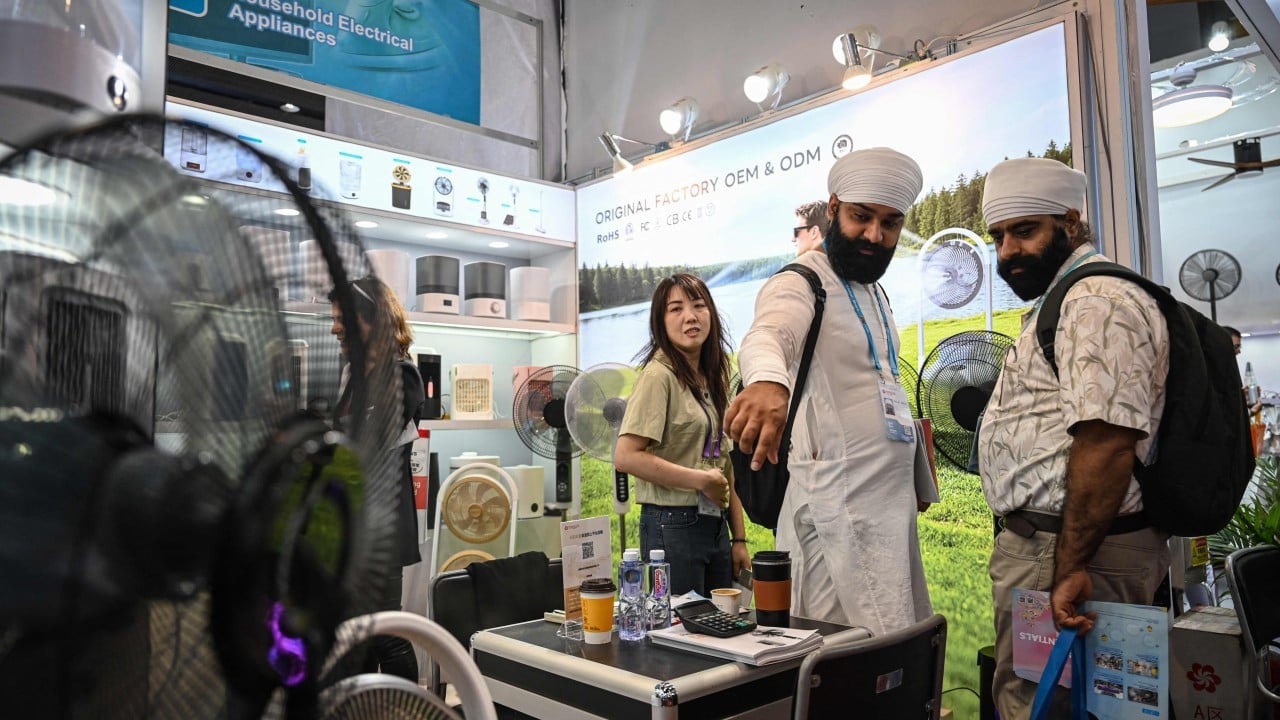
The air inside the Pazhou Complex in Guangzhou doesn't smell like global diplomacy. It smells like ozone, floor wax, and the frantic, slightly metallic scent of industrial air conditioning working overtime against the humid South China spring.
Li Wei stands at the edge of his booth, smoothing the lapels of a suit that has seen better days. He is surrounded by high-efficiency brushless motors—the literal heartbeat of the modern world. Around him, the 135th Canton Fair is humming at a frequency that suggests everything is fine. The numbers certainly say so. The gates swung open to a record-breaking 246,000 overseas buyers, a 24.5% jump from the previous session. On paper, this is a triumph. In reality, Wei is watching the horizon, and the clouds are turning a bruised purple.
It is a strange irony. At the very moment China’s "Greatest Show on Earth" breaks its own attendance records, the world outside seems intent on pulling itself apart.
The Ghost at the Banquet
To understand the tension in the aisles, you have to look past the gleaming EV chargers and the ranks of solar panels. You have to look at the buyers from the Middle East. They are here in force, their presence a testament to a deepening pivot in global trade. But they carry with them the weight of a region on the brink.
As the fair opened, the shadow of conflict in the Levant loomed over every negotiation. When a buyer from Dubai sits down with a manufacturer from Ningbo, they aren't just talking about unit prices or shipping containers. They are talking about the Red Sea. They are talking about insurance premiums that have tripled overnight. They are talking about the terrifying possibility that a cargo ship carrying 5,000 washing machines might become a floating casualty of a war that neither of them started.
Wei knows this dance well. He watches a regular client from Jordan approach his booth. Usually, they embrace. Today, the greeting is stiff. The client doesn't ask about the new specifications of the $5.5\text{kW}$ motor. He asks about lead times. He asks if the shipping routes are pivoting around the Cape of Good Hope.
That detour adds two weeks to a journey. It adds thousands of dollars in fuel. In the cutthroat world of low-margin manufacturing, those two weeks are the difference between a profit and a bankruptcy filing.
The Arithmetic of Anxiety
We often treat global trade like a series of digital transactions, clean and bloodless. It isn't. It is a physical struggle against gravity, distance, and the rising cost of existing.
Consider the "Three New" industries that China is betting its future on: electric vehicles, lithium batteries, and solar cells. These are the stars of this year's fair. They are supposed to be the engines of a new era. But these engines are running on expensive fuel.
Domestically, the "involution"—a term Chinese business owners use to describe a soul-crushing, hyper-competitive race to the bottom—is reaching a fever pitch. To stay relevant, factories are slashing prices to levels that defy logic. This isn't just competition; it's a slow-motion demolition derby.
"I can give you the best price in the world," Wei tells a skeptical buyer from Brazil. "But I cannot give you the old price."
He’s referring to the invisible tax of the modern era. Labor costs in the Pearl River Delta are no longer the pittance they were twenty years ago. Raw material costs are volatile. And then there is the specter of protectionism. Europe and the United States are erecting walls—tariffs, probes, and "de-risking" strategies—that make the smooth flow of goods feel like a memory from a different century.
The logic is simple. If you are a Chinese exporter, you are caught in a pincer movement. On one side, the cost of making things is rising. On the other, the cost of moving things is exploding. In the middle, the customer is demanding a discount because their own economy is sputtering.
The Digital Mirage
Walking through the hardware section, you see booths that look like movie sets. There are live-streamers with ring lights shouting into smartphones, selling industrial drill presses to audiences in Jakarta and Riyadh simultaneously. It’s a frantic, digital energy.
This is the "New Quality Productive Forces" in action—a push toward high-tech, high-efficiency output. But technology doesn't solve the fundamental human problem of trust.
One buyer, a man named Marcus who has traveled from Germany, stands staring at a wall of modular battery storage units. He’s been coming to Guangzhou for fifteen years.
"The tech is better than ever," Marcus says, rubbing his eyes. "But the world is louder. Fifteen years ago, I bought based on quality. Now, I buy based on geopolitics. I have to ask: if I commit to this supplier, will their country be at odds with mine in six months? Will my government even let these batteries into the port?"
This is the hidden cost of the Canton Fair. It’s a tax on certainty. When the geopolitical weather is unpredictable, everyone starts carrying an umbrella, even when the sun is shining. That umbrella is expensive. It takes the form of diversified supply chains, "just-in-case" inventory, and a constant, low-grade fever of worry.
The Resilience of the Small
Despite the "Middle East cloud," as the headlines call it, the fair is not a somber affair. There is a defiant, almost desperate vitality to it.
You see it in the way a small-scale textile manufacturer from Zhejiang spends three hours explaining the weave of a microfiber towel to a buyer from Kenya. They aren't discussing the macro-economic shifts of the G20. They are discussing the feel of the fabric against the skin.
There is a profound human stubbornness in trade. People want to build things. They want to sell things. They want to provide for their families and grow their small corners of the world. This primal drive is what keeps the Pazhou Complex full, even when the shipping lanes are blocked and the tariffs are rising.
The records being set—the sheer number of bodies in the hall—are a scream for normalcy. They represent a global business community that is tired of "interesting times." They are here because the alternative is to stop, and in the world of global commerce, stopping is a death sentence.
A Balance of Power
As the sun begins to set over the Pearl River, casting long, golden shadows across the glass facade of the exhibition hall, the true scale of the challenge becomes clear.
China is no longer just the "world’s factory." It is a sophisticated, high-tech powerhouse trying to navigate a world that is increasingly wary of its reach. The Middle East, meanwhile, is seeking a new partner in its own journey toward a post-oil future. These two forces are colliding in the aisles of the Canton Fair, creating a new, uncertain friction.
The numbers will tell you the fair was a success. They will point to the billions of dollars in intended deals and the hundreds of thousands of badges scanned at the gate. But the numbers don't feel the sweat on a manufacturer's palm when a shipping quote comes back 40% higher than last month. They don't hear the silence when a long-term partner mentions a new factory they are opening in Vietnam or Mexico "just to be safe."
Wei packs up his samples at the end of the day. He has three solid leads—one from Egypt, one from Russia, and one from a domestic buyer looking to upgrade a factory in the north. It is enough to keep his machines running for another quarter.
He walks out toward the metro station, blending into a sea of thousands of other entrepreneurs, each carrying a heavy briefcase and a heavier set of questions. They are the gears of a global machine that is grinding, sparking, and groaning under the weight of a changing world order.
The lights of the Pazhou Complex stay on long into the night, reflecting off the dark water of the river. It is a lighthouse in a storm, but the lighthouse doesn't control the waves. It only shows you where the rocks are.
We are all navigating by that light now, hoping that the next handshake across a booth table is strong enough to hold back the tide.