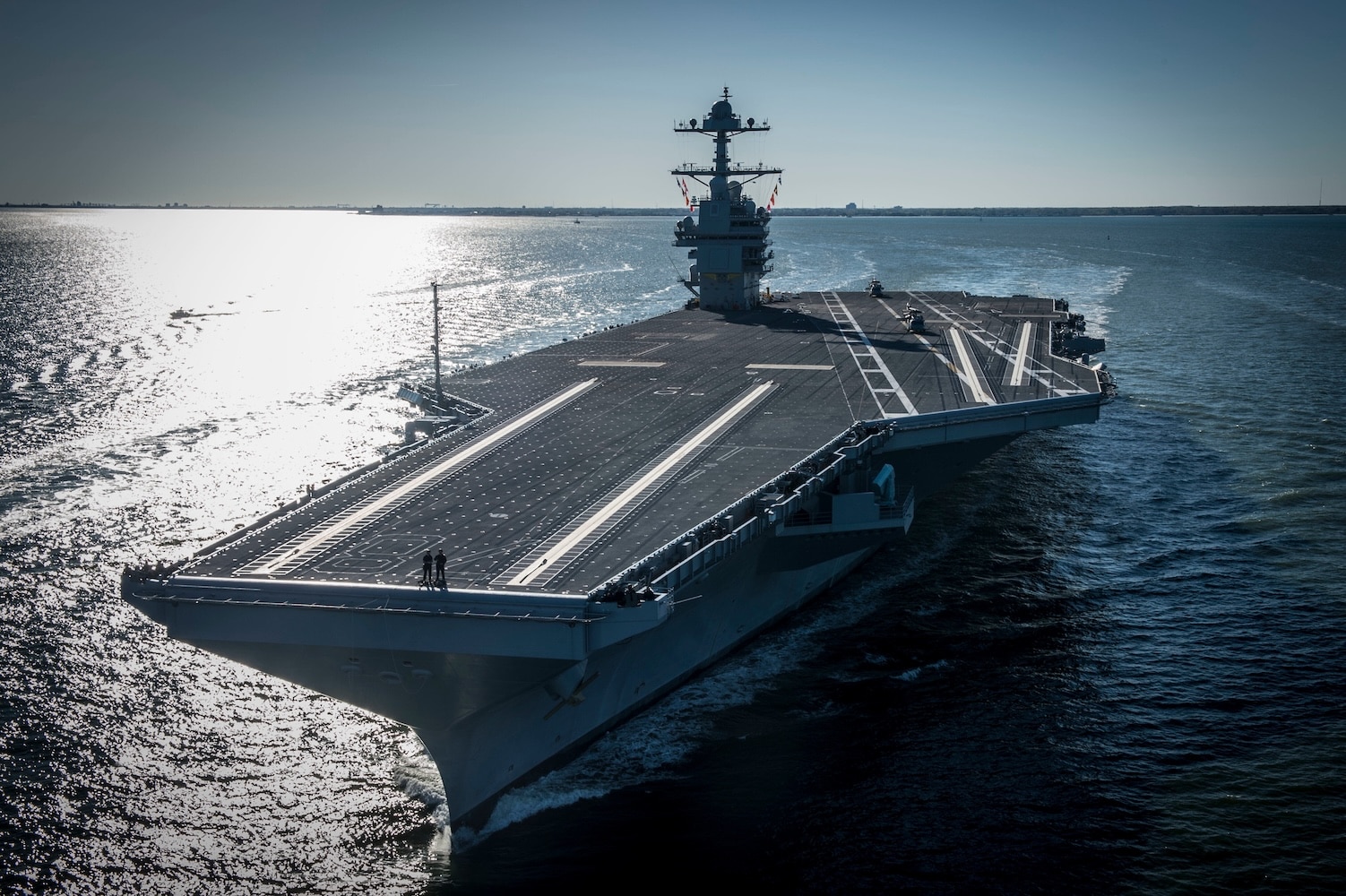
The steel deck of the USS Gerald R. Ford stretches across the Atlantic like a floating piece of Manhattan, a 1,100-foot monument to human ambition. It is not just a ship. It is a nuclear-powered ecosystem, a fortress of five thousand souls, and the most expensive instrument of sovereign will ever constructed. When it moves, the world watches. When it stops, the world wonders why.
On a Tuesday that began with the rhythmic, metallic pulse of daily operations, that rhythm broke. If you enjoyed this article, you should check out: this related article.
Smoke is a different animal at sea. On land, you run away from a fire; on a warship, you are trapped in a steel box with it. In the belly of this $13.3 billion leviathan, a localized fire broke out. It didn't take down the ship. It didn't sink the pride of the Navy. But it did something more subtle and perhaps more unsettling: it reminded everyone that even the most advanced technology in existence is ultimately at the mercy of a single, stray spark.
The Ghost in the Machine
To understand why a small fire on a massive ship matters, you have to understand what the Ford actually is. It isn't just a bigger version of the Nimitz-class carriers that preceded it. It is a radical departure. It replaces steam with magnets. It replaces manual valves with fiber optics. It is a leap into a future where software governs the launch of a forty-ton fighter jet. For another look on this development, check out the latest coverage from BBC News.
Imagine a sailor—let’s call him Petty Officer Miller—standing in a narrow passageway when the alarm sounds. Miller isn't thinking about the geopolitical implications of the Ford’s presence in the Mediterranean or the North Sea. He is thinking about the "Afloat Training Group" standards. He is thinking about the smell of electrical insulation burning, a sharp, chemical tang that cuts through the recycled air.
The Navy reported the incident with the practiced, sterile vocabulary of military bureaucracy. They called it a "localized fire." They noted it was "quickly extinguished." They confirmed no serious injuries. This is the language of reassurance. But for the crew, the event was a visceral interruption of the "Blue Water" routine.
The ship was forced to turn toward port.
A temporary stay in Norfolk or a nearby shipyard wasn't the plan. The Ford was supposed to be the vanguard, the untouchable titan. Instead, it became a reminder of the friction between theory and reality. You can simulate a thousand scenarios in a lab in Virginia, but you cannot simulate the way salt air and high-voltage stress interact over six months of grueling deployment.
The Fragility of Power
The Ford carries the weight of a nation’s expectations. For years, it was criticized for its delays, its "Advanced Weapons Elevators" that wouldn't move, and its electromagnetic catapults that hesitated. By 2024 and into 2025, it seemed the ship had finally found its stride, proving the skeptics wrong by maintaining a blistering pace of flight operations.
Then came the smoke.
There is a specific kind of silence that falls over a ship when the engines cycle differently or when the ventilation shuts down to isolate a fire zone. It is a heavy, expectant silence. In those moments, the complexity of the ship becomes a liability. The Ford has over 600 fewer crew members than older carriers, thanks to automation. But automation cannot grab a fire extinguisher. Automation cannot smell a smoldering wire behind a bulkhead before a sensor trips.
When the ship pulls into port for "temporary" repairs, it isn't just about fixing a scorched electrical panel. It is about the diagnostic nightmare of a digital warship. In the old days, if something broke, you hit it with a wrench or welded it back together. On the Ford, a fire can trigger a cascade of sensor errors that require engineers to dive into millions of lines of code and miles of sophisticated cabling.
The stakes are invisible but absolute. If the Ford is sidelined, the "chess board" of global naval strategy has a glaring hole. A carrier strike group without its carrier is a collection of bodyguards with no one to protect. The fire wasn't just an accident; it was a mechanical heart attack in a body that was supposed to be invincible.
The Human Element in a Digital Hull
Consider the engineers who now have to crawl into the cramped, scorched spaces to find the "why." These are men and women who work in the shadows of the flight deck’s glamour. They don’t get the "Top Gun" moments. They get grease-stained coveralls and the relentless heat of the machinery spaces.
For them, this port visit isn't a vacation. It is a race.
They are fighting the narrative as much as the hardware. Every time the Ford returns to port unexpectedly, the "white elephant" labels start flying again in Washington. The crew feels this. They carry a chip on their shoulders, a desire to prove that this ship is the future of American power, not a cautionary tale of over-engineering.
The fire was small, yes. But in the vacuum of a steel hull, nothing is truly small. A single short circuit in a power distribution room can, through a series of unfortunate events, theoretically blind a radar system or stall a catapult. The Navy’s decision to return to port was an act of extreme caution, a "safety stand-down" in physical form. It was an admission that with a platform this expensive and this vital, you don't take a 1% risk.
The Cost of the Edge
Why do we build these things? Why pour the GDP of a small country into a single hull that can be halted by a localized blaze?
Because the Ford represents the "edge." In modern conflict, the side that can launch planes faster, see further, and generate more electrical power for future laser weapons is the side that wins without firing a shot. The Ford is a deterrent. It is a 100,000-ton message.
But messages get garbled.
The transition from steam to electromagnetics is like moving from a typewriter to a quantum computer. It’s beautiful when it works, but when the screen goes black, you can’t just ribbon-correct it. This temporary port visit is the growing pains of a new era. We are watching the messy, unpolished reality of how the future is actually forged. It isn't forged in a smooth, linear line of progress. It is forged in setbacks, in midnight repairs, and in the smoke of a Tuesday morning.
The ship will sail again. The charred components will be replaced. The soot will be scrubbed from the bulkheads. But the incident lingers as a ghost in the system. It serves as a grounded, sobering check on the idea that technology can ever fully eliminate the chaos of the sea.
As the Ford sits in the harbor, dwarfing the piers, its massive hull reflects in the still water. It looks like a mountain of steel, unmoving and eternal. Yet, inside, a small army of technicians is proving that the world's most powerful warship is actually a delicate web of connections, each one vital, each one vulnerable.
The fire is out. The lesson remains. We build these titans to dominate the horizon, but we maintain them in the dark, cramped corners where the wires meet the salt. The true strength of the Gerald R. Ford isn't in its nuclear reactors or its stealthy profile. It is in the resilience of the people who refuse to let a spark turn a masterpiece into a memory.
The ocean is waiting. It always is. It doesn't care about price tags or political optics. It only cares about the integrity of the hull and the vigilance of the watch.
The Ford will return to the deep water, heavier for the experience, and the world will watch once more.
The spark was a warning. The response will be the proof.