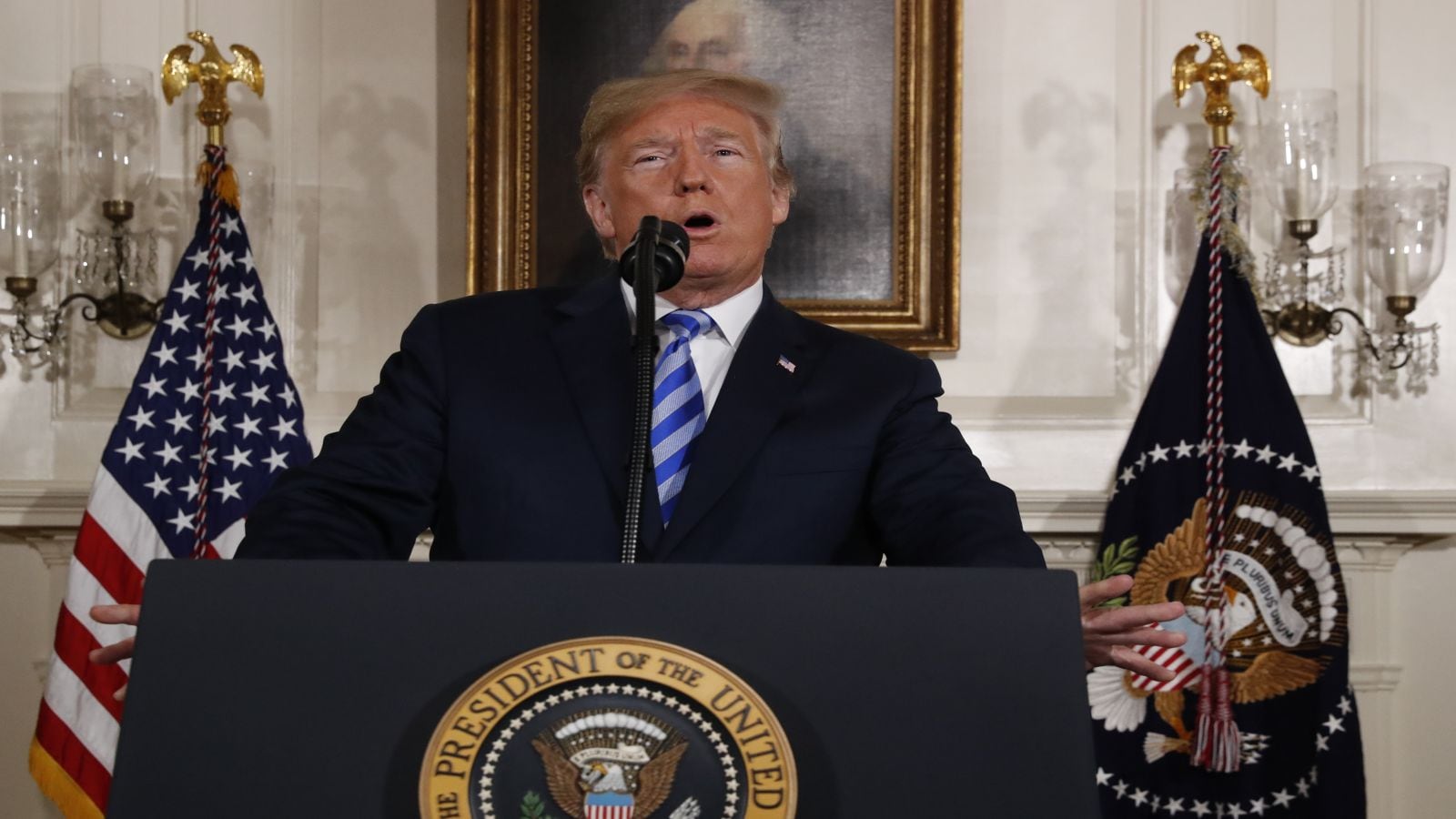
The financial press is running its usual play. Former President Donald Trump threatens a 100 percent tariff on any nation that imposes a digital services tax (DST) on American tech giants, and the headlines immediately descend into standard partisan panic. Half the commentators decry the return of destructive protectionism. The other half cheer for the muscular defense of American corporate champions like Alphabet, Meta, and Amazon.
They are both missing the point.
The entire debate around digital services taxes and retaliatory tariffs is built on a fundamental misunderstanding of how modern corporate finance and sovereign borders interact. The mainstream media treats this as a classic trade war—a digital version of steel tariffs. It isn't. This is a structural clash between an obsolete, century-old physical tax system and a hyper-mobile, decentralized digital economy.
Threatening a 100 percent tariff to stop Europe or Canada from taxing Google isn’t just bad diplomacy; it is an obsolete solution to an entirely different problem. The digital services tax isn’t a trade barrier designed to hurt America. It is a desperate, messy attempt by foreign governments to catch up to tax-avoidance strategies that the United States itself created and codified.
Here is the truth nobody in Washington or Wall Street wants to admit: The tech giants aren’t victims. Foreign governments aren’t thieves. And tariffs will only accelerate the fragmentation of the global economy, harming the exact American companies they are meant to protect.
The Lazy Consensus on Digital Services Taxes
To understand why a 100 percent tariff is a catastrophic tool, you have to look at the "lazy consensus" surrounding DSTs. The standard narrative claims that countries like France, the UK, Italy, and Canada are inventing arbitrary taxes to unfairly target American innovators because their own domestic tech sectors can't compete.
This argument ignores how international corporate taxation actually works. For decades, the global tax system has relied on the concept of "permanent establishment." If a company has a physical factory, an office, or an inventory warehouse in a country, that country gets to tax its profits. If there is no physical presence, there is no tax liability on those profits.
Silicon Valley perfected the art of exploiting this loophole. Through intellectual property shifting—mechanisms like the old "Double Irish with a Dutch Sandwich"—a tech giant could generate billions of dollars in revenue from French users clicking on French ads, while legally routing all those profits through a low-tax jurisdiction like Ireland, Bermuda, or the Cayman Islands.
I have watched Fortune 500 tech firms execute these structures for over fifteen years. The reality is brutal: American tech companies extract immense economic value from foreign populations while paying fractions of a percent in local corporate income taxes.
A digital services tax is not a tariff on goods. It is a gross revenue tax aimed specifically at digital advertising, marketplace fees, and user data monetization. Foreign governments aren't trying to block American trade; they are trying to tax the economic activity happening entirely within their own borders.
When Trump threatens a 100 percent tariff to protect these tax structures, he is effectively deploying the full power of the United States military and economic apparatus to defend the right of private multinationals to avoid paying taxes anywhere on earth.
Why Tariffs Cannot Defeat Digital Mobility
The premise of the 100 percent tariff threat is that economic pain will force foreign sovereigns to capitulate. It assumes a physical asymmetry: We buy your cars and wine; you buy our software. If we block your cars and wine, you will stop taxing our software.
This logic breaks down against the laws of economic incidence. When you slap a 100 percent tariff on French wine, German autos, or Canadian timber, the foreign exporter does not pay that tax. The American importer pays it, and the American consumer absorbs the cost.
More importantly, it fails to account for how easily digital assets move compared to physical supply chains. If the United States imposes sweeping tariffs, affected nations will not simply roll back their DSTs. They will double down.
Imagine a scenario where the U.S. levies severe tariffs on European goods. In response, the European Union doesn't just keep its 3 percent DST; it escalates the measure into a targeted regulatory assault. They can restrict cross-border data flows under GDPR (General Data Protection Regulation), mandate localized data storage, or levy direct fines on American platforms for antitrust violations.
You cannot use a physical wall (tariffs) to police an invisible, decentralized network (the internet). A tariff on a physical good happens at a port of entry. A digital service bypasses the port entirely. If a nation decides to throttle or heavily tax the digital revenue generated within its borders, a U.S. customs agent at the Port of Los Angeles cannot stop them.
The defense of American tech via trade retaliation creates a highly predictable, highly destructive loop:
- The U.S. threatens catastrophic tariffs on physical imports.
- Foreign nations implement or increase digital services taxes to offset economic pressure and assert sovereignty.
- The U.S. executes the tariffs, driving up domestic inflation and hurting American retail, manufacturing, and consumer sectors.
- Foreign nations retaliate by targeting the core infrastructure of American tech—restricting cloud operations, data centers, and licensing agreements.
In this scenario, the tech companies lose their global market share, American consumers pay double for imports, and the underlying tax dispute remains completely unresolved.
The True Cost of Protecting Stateless Capital
The ultimate irony of this protectionist stance is that the United States government is bleeding its own tax revenue to defend companies that actively avoid hoarding wealth within the U.S. borders.
When a company like Meta or Alphabet avoids European tax via an offshore subsidiary, that capital does not automatically return to the United States treasury. It sits in offshore holding companies or is used for stock buybacks to enrich shareholders. The domestic American worker derives almost zero benefit from a tech company successfully dodging a local tax in Toronto or Paris.
By threatening massive tariffs to shield these specific corporate entities, the federal government is picking winners and losers in the domestic economy. It is sacrificing the American manufacturing worker, the agricultural exporter, and the automotive retail sector—all of whom will bear the direct brunt of retaliatory tariffs—to preserve the profit margins of a handful of hyper-capitalized technology monopolies.
Consider the agricultural sector. Every time the United States engages in tariff brinkmanship, the immediate counter-measure from foreign trading partners is a targeted tariff on American soybeans, pork, and dairy. Washington then has to spend billions of dollars in taxpayer-funded bailouts to keep American farmers afloat.
We are systematically destroying tangible, domestic economic sectors to subsidize the tax-avoidance strategies of intangible, multinational platforms. It is an economic trade-off that makes zero mathematical sense.
Dismantling the Premise of the Corporate Defense
The defensive arguments put forward by trade trade representatives usually center on a single question: "Isn't it the duty of the U.S. government to defend American companies from discriminatory foreign taxes?"
The question itself is flawed. It assumes that these taxes are inherently discriminatory based on nationality. They are not. They are discriminatory based on business model.
A well-drafted DST applies to any company that hits a specific global and domestic revenue threshold for digital operations. If a massive Chinese digital marketplace or a European streaming giant hits those same thresholds, they pay the exact same tax. The reason the tax hits American companies hardest is not because of a anti-American conspiracy; it is because American companies currently hold a near-monopoly on global digital infrastructure.
If you build an empire that spans the globe, extracts data from billions of foreign citizens, and drives local media companies out of business by consuming the entirety of the global advertising market, you cannot act shocked when those local jurisdictions demand a seat at the revenue table.
Sovereignty matters. A nation-state has a fundamental right to determine how commerce is taxed within its geographic borders. When the U.S. attempts to veto that right through economic bullying, it doesn't preserve the global order—it destroys it.
The Fractured Internet and the End of Global Tech
The real danger of the 100 percent tariff threat is not a temporary drop in stock prices or a short-term trade dispute. The danger is the permanent balkanization of the global technology sector.
For the past three decades, American tech companies have scaled at unprecedented rates because the internet remained relatively open and global. A single codebase developed in Mountain View or Seattle could be deployed globally with minimal friction. That era is ending, and the aggressive misuse of tariffs will speed up its demise.
Faced with massive U.S. tariffs, foreign nations will realize that relying on American digital infrastructure is a national security risk. If using AWS, Google Workspace, or Microsoft Azure means your domestic economy can be held hostage by Washington policymakers over a local tax dispute, the logical move is to build sovereign alternatives.
We are already seeing the early stages of this shift. Nations are mandating "sovereign clouds"—data infrastructure completely decoupled from American legal and political jurisdiction. European and Asian states are funding domestic tech ecosystems specifically designed to replace American platforms.
If Washington forces a hard line with a 100 percent tariff, it will incentivize the rest of the world to systematically purge American technology from their corporate and governmental operations. The long-term loss of global market access will cost Silicon Valley infinitely more than a 3 percent gross revenue tax ever would.
Stop treating digital services taxes as an act of economic warfare that can be crushed with a meat cleaver like a shipping tariff. They are an inevitability of the digital age. The solution isn't to burn down the global trading system to protect a few offshore corporate balance sheets. The solution is to rewrite the global tax architecture entirely, acknowledging that data has value, location matters, and no corporation gets to operate in a society completely for free.
The tariff threat is a loud, weak bluff from an administration using a twentieth-century playbook to fight a twenty-first-century economic reality. It will fail, and the companies it claims to protect will be the ones left holding the bill.